
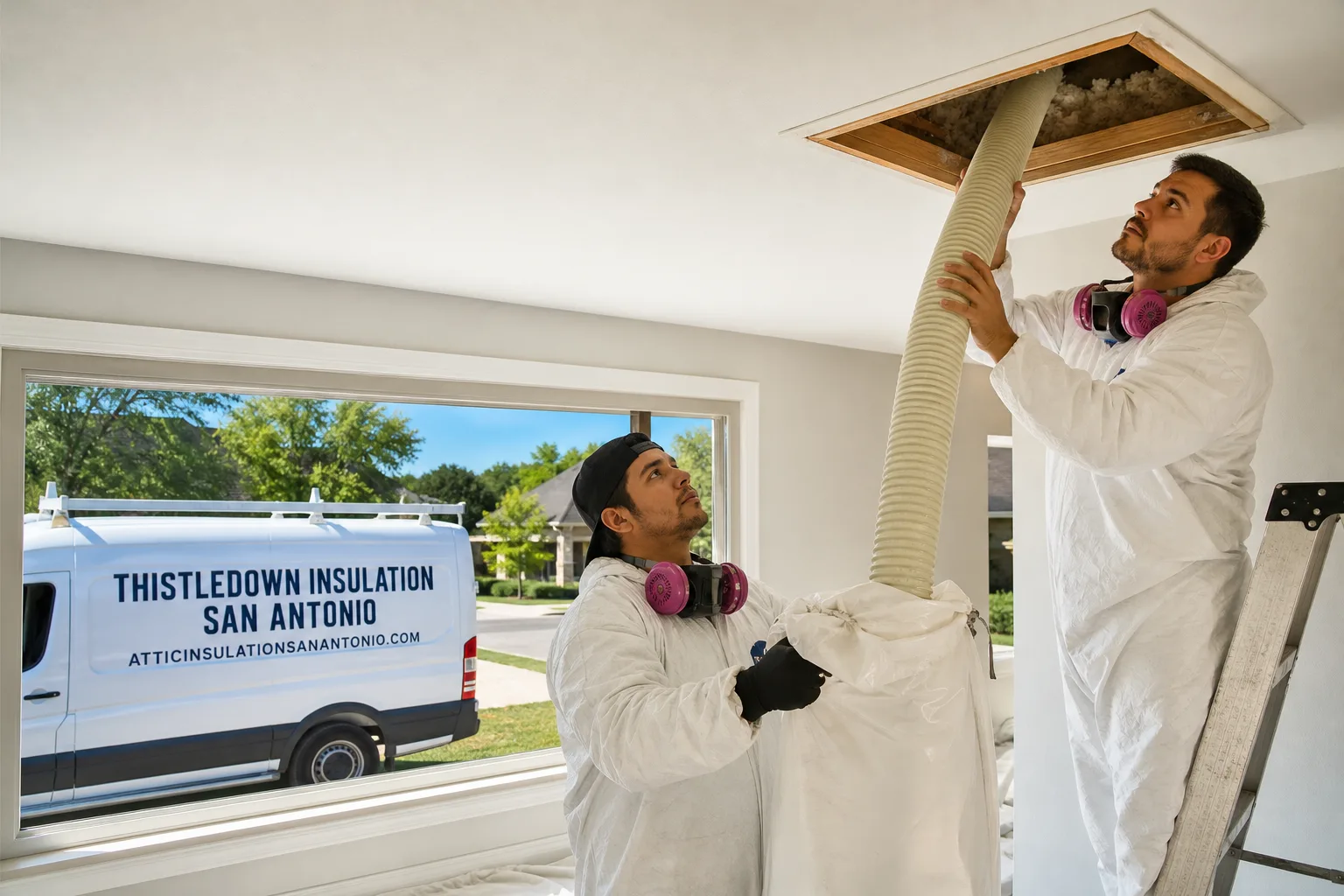
How Much Does Wall Insulation Cost in San Antonio?
Wall insulation in San Antonio typically costs between $1.50 and $4.50 per square foot installed, with most homeowners spending $1,800 to $6,200 total for an average project in 2026. A standard 1,500-square-foot exterior wall retrofit using blown-in cellulose or injection foam runs $2,200 to $4,800, while new-construction batt installation during framing costs less, usually $900 to $2,400 for the same wall area. The exact number depends on your wall type, insulation material, and whether we’re working in an existing home or new construction, but you’ll have a written price before any work begins.
Those are real numbers for this market. Not national averages with San Antonio pasted on top. We price based on what we actually see in Alamo Heights, Stone Oak, Helotes, and the older neighborhoods inside Loop 410, where wall cavities, access points, and existing insulation vary house to house.
If you want a specific quote for your walls, call (903) 437-9164 and a live person will pick up, 24 hours a day. Estimates are free, and the number we give you is the number you’ll pay.
Wall Insulation Cost Breakdown (2026)
Here’s what wall insulation costs look like across the San Antonio metro in 2026, broken down by material and project type. These are mid-range installed prices that include labor, materials, and cleanup. Your written quote from Thistledown will reflect your exact wall measurements, but this gives you a working budget before we visit.
| Wall Insulation Type | Cost per Sq Ft (Installed) | Typical Total for 1,200 Sq Ft of Wall | Best For |
|---|---|---|---|
| Fiberglass batt (new construction, open walls) | $1.10 – $2.10 | $1,320 – $2,520 | New builds, additions, gut renovations |
| Blown-in cellulose (existing walls, drill-and-fill) | $1.80 – $3.20 | $2,160 – $3,840 | Retrofit older homes without opening drywall |
| Injection foam (existing walls, drill-and-fill) | $2.60 – $4.50 | $3,120 – $5,400 | Retrofit with air-sealing benefits |
| Spray foam (open-cell, open walls) | $2.40 – $3.90 | $2,880 – $4,680 | New construction, attached garages, bonus rooms |
| Spray foam (closed-cell, open walls) | $3.50 – $5.60 | $4,200 – $6,720 | Flood-prone areas, maximum R-value per inch |
| Rockwool batt (open walls) | $1.70 – $2.90 | $2,040 – $3,480 | Fire resistance, sound dampening, pet-safe focus |
Those costs shift based on a handful of things we’ll walk through below. But first, know this: whatever the table says, the number on your written quote is the number you’ll pay. We don’t do “change orders” or end-of-job surprises. That’s not how we work, and it’s written into every proposal.
What Drives Wall Insulation Cost Up or Down
Wall insulation is not a flat-rate service. Two houses on the same street in King William or Monte Vista can land at very different final numbers. Here’s why.
Whether walls are open or closed. New construction with stud bays exposed is the least expensive scenario. Workers install batts or spray foam directly into open cavities before drywall goes up. Existing homes need drill-and-fill: we bore small holes through exterior siding or interior drywall, blow or inject insulation into each cavity, then patch. It’s more labor per square foot, and that shows up in the price.
Wall cavity depth. Older San Antonio homes, especially those built before the 1970s, often have true 2×4 walls (3.5 inches deep) rather than modern 2×6 framing (5.5 inches). Less depth means less insulation capacity and sometimes more careful product selection. Some pre-1950 homes in the Monte Vista Historic District have unusual framing that requires slower, more careful work.
Access to walls. Single-story homes with clear exterior access make drill-and-fill straightforward. Two-story houses add ladder work and longer hose runs. Walls behind built-in shelving, tile, or masonry veneer take more planning. If the only practical access is from inside, we protect floors and furniture, and that prep time is part of the quote.
Current insulation condition. Some San Antonio homes have old, settled, or rodent-damaged insulation in wall cavities. In those cases we remove what’s there before adding new material. Removal adds cost but skips future problems. We’ll tell you if your walls have this issue before we quote, not after we open them up.
Product choice. Batt fiberglass sits at the low end. Blown-in cellulose lands in the middle and performs well in San Antonio’s heat. Injection foam and closed-cell spray foam cost more but add air sealing, which matters in a climate where summer humidity creeps into anything with a gap. We carry eight brands including Owens Corning, Johns Manville, Knauf, Rockwool, CertainTeed, Icynene, Demilec, and GreenFiber, and we’ll match the product to your wall type and your family’s needs, including pet-safe options where a choice exists.
What Affects Wall Insulation Pricing in San Antonio
Beyond the basics, these are the San Antonio-specific factors that move your wall insulation number.
- Home age and framing style. Homes built before 1960 inside Loop 410 often have plaster walls over wood lath, which changes drill-and-fill technique. Many post-1980 suburban homes in Stone Oak and Alamo Ranch use standard 2×4 or 2×6 framing that’s faster to work with. Older construction generally means more labor per square foot.
- Exterior finish type. Brick veneer, common across San Antonio, requires drilling through mortar joints rather than siding, which takes more care. Stucco homes, popular in neighborhoods like Terrell Hills, need patching that matches texture. Hardie plank and vinyl siding are the simplest to drill and patch.
- Wall height and roof pitch. Two-story homes and walls under steep rooflines mean more time on ladders and more safety setup. That labor is reflected honestly in the quote, never buried as a surprise.
- Time of year. San Antonio insulation work is busiest in May through August, when people suddenly remember their upstairs bedrooms feel like ovens. Late fall and winter can sometimes offer quicker scheduling, though our written pricing stays consistent year-round.
- Existing wall penetrations. Outlets, windows, and plumbing runs create thermal breaks. Properly insulating around them takes time. We’ll account for every penetration in the quote so you’re not surprised later.
- Permit and code requirements. Most wall insulation retrofits in San Antonio don’t require a permit, but if your project is part of a larger renovation with open walls, the city’s building code applies. We’ll tell you upfront if your project triggers anything beyond standard installation.
Wall Insulation Costs by San Antonio Neighborhood (What We See)
This is what our crews observe across different parts of the city. It’s not a pricing map, but it explains why your neighbor’s quote might differ from yours.
Older neighborhoods inside Loop 410 (Monte Vista, King William, Alta Vista, Beacon Hill): These homes run 1930s to 1960s, mostly pier-and-beam with plaster interior walls and wood or brick exterior. Wall cavities are often empty or minimally insulated. Drill-and-fill through stucco or brick takes patience. Expect mid-to-high range per square foot due to access and wall depth. Typical totals: $2,800 to $6,000.
Mid-century suburbs (Castle Hills, Terrell Hills, Northwood, Oak Hills): Homes from the 1960s through early 1980s, often single-story brick, sometimes with original batt insulation that’s settled or absent in places. Drill-and-fill from the exterior is usually straightforward. Typical totals: $2,200 to $5,000.
Newer developments (Stone Oak, Alamo Ranch, Cibolo, Schertz, west side growth corridors): Houses built since the 1990s generally have some wall insulation already, but it’s often builder-grade fiberglass batt that underperforms in San Antonio’s heat. Upgrades or additions are most common here. Typical totals for new wall work: $1,800 to $4,500, with additions and custom spaces at the higher end.
Historic districts (La Villita, Lavaca, parts of Southtown): Some of these homes fall under historic review rules. Wall insulation work is usually allowed through interior access or less visible exterior approaches, but coordination takes extra time. We’ll handle the details and quote accordingly.
How Does Wall Insulation Compare to Attic Insulation for Return on Investment?
In San Antonio, attic insulation is usually the first priority because heat rises into the attic and then radiates down into living space. But walls matter too, especially west-facing walls that bake in the afternoon sun. Homes lose a meaningful portion of cooling through uninsulated or under-insulated walls. If your attic is already done at R-38 or higher and your upstairs rooms still heat up by 4 p.m., the walls are often the missing piece.
Wall insulation costs more per square foot to install than attic insulation because walls are harder to access. But the comfort payoff shows up in rooms that face west, rooms over garages, and any room that shares a wall with an unconditioned space. If you’re weighing attic versus wall insulation, our team can assess both and give you a written breakdown for each, so you can decide what to do now and what to defer. Call (903) 437-9164 and we’ll schedule a look at the whole house, not just the walls.
How to Save on Wall Insulation in San Antonio
Saving on wall insulation shouldn’t mean cutting corners. Here are practical ways to lower your project cost without lowering the quality of the work.
- Do walls and attic together if both need work. Combining projects means one mobilization, one clean-up, and often a better per-square-foot number. Ask us to price both separately and together so you can see the difference.
- Choose the right material for your wall depth. In a 2×4 wall, closed-cell spray foam gets more R-value per inch but costs more. Cellulose or fiberglass batt may get you acceptable performance for less. We’ll show you real options with numbers, not a one-size-fits-all recommendation.
- Check for CPS Energy rebates before you start. CPS Energy in San Antonio periodically offers rebates for insulation upgrades, including wall insulation in some programs. We’ll tell you what we know is currently available, but rebate programs change, so confirm the most recent terms directly with CPS.
- Time your project outside peak season. Late fall and winter are less busy for San Antonio insulation crews. The pricing doesn’t change, but scheduling flexibility can be better, and we can often complete a wall project with minimal disruption to your household.
- Get a written quote, not a verbal range. A real number lets you compare apples to apples. Our quotes are written, itemized, and they don’t change once you approve them. The free estimate is just a phone call away: (903) 437-9164.
Why San Antonio Homeowners Choose Thistledown for Wall Insulation
We’re a Cedarwell-family company, which means we work to a standard, not a mood. Every Thistledown crew follows the same C.A.R.E. values on every visit: clean up like it’s our own home, ask before we move or touch anything, respect the family’s time and quiet hours, and explain the price before the work. Those aren’t slogans on a van. They’re the instructions our technicians get before they walk through your door.
Thistledown is the soft fluff of the thistle, one of nature’s lightest insulators. The name is a promise about how carefully we work. We carry that into every San Antonio home we enter.
What that looks like in practice: shoe covers go on at the front door and stay on until we leave. Drop cloths cover floors from the entry to the work area, because insulation work involves moving materials and drilling access holes. When the job is done, we photograph the cleaned area before we pull away, and that photo is part of our close-out. You’ll know exactly what your floors look like after we’re gone, because you’ll have proof.
We also understand that many San Antonio homes have kids and pets. We choose pet-safe insulation products where a choice exists, so the dog can be home during the job. We use quiet tools when children are sleeping. And if you tell us the baby’s nap schedule, we’ll plan the noisy parts around it. That’s not an upsell. It’s baseline Thistledown behavior.
Every job is backed by the 365-Day Done Right Promise. If it’s not done right, we make it right. No debate, no fine print. And every customer receives a written price before any work starts, always included, never conditional. Founded in 2003, we’ve been insulating homes under the Cedarwell standard for over two decades. Our technicians are background-checked and uniformed, so you always know exactly who is walking through your door, and every call to (903) 437-9164 is answered by a live person, 24 hours a day, seven days a week. No voicemail trees. No next-business-day callbacks.
We carry eight insulation brands: Owens Corning, Johns Manville, Knauf, Rockwool, CertainTeed, Icynene, Demilec, and GreenFiber. That range exists so the right product is matched to each wall system and each family’s needs, not because we stock whatever’s cheapest and push it on everyone. If you’re not sure which material fits your home, our Wall Insulation in San Antonio guide walks through the options in plain language. And if you’re just starting your research, our home page covers the full scope of what we do.
Wall Insulation Cost FAQs
How much does it cost to insulate existing walls in San Antonio?
Insulating existing walls in San Antonio typically costs $1,800 to $5,400 for drill-and-fill work on a standard single-story home, or $1.80 to $4.50 per square foot of wall area. The range reflects material choice (cellulose at the low end, injection foam at the high end) and wall accessibility. Homes with two stories, brick veneer, or plaster interiors land at the higher end. Call (903) 437-9164 for an exact quote, free of charge.
How much does it cost to insulate walls in new construction in San Antonio?
New construction wall insulation in San Antonio runs $1.10 to $2.90 per square foot of wall area for batt products, or $2.40 to $5.60 per square foot for spray foam, depending on open-cell versus closed-cell. A 1,200-square-foot wall area costs $1,320 to $6,720 total depending on material. Since stud bays are open and accessible, labor is lower per square foot. For a written number on your build, call (903) 437-9164.
Is wall insulation worth the cost in San Antonio’s climate?
Wall insulation typically pays for itself through reduced cooling costs, with the biggest comfort gains in rooms with west-facing walls that absorb afternoon heat in San Antonio’s long summers. Homes with uninsulated or under-insulated walls lose cooled air through the wall assembly, and the problem is most noticeable between 3 p.m. and 7 p.m. from May through September. If your attic already has adequate insulation but specific rooms still run warm, walls are usually the next logical step.
Can you insulate walls without removing drywall?
Yes, drill-and-fill insulation allows us to insulate existing walls without tearing out drywall. We create small access holes, typically through exterior siding or mortar joints, blow or inject insulation into each stud cavity, then patch the holes. Most projects in San Antonio are completed in one day for a single-story home, with patching blended to match the existing finish as closely as possible. This method adds labor cost compared to open-wall installation, but it avoids the much larger expense of drywall replacement and repainting.
How much does injection foam wall insulation cost in San Antonio?
Injection foam wall insulation in San Antonio runs $2.60 to $4.50 per square foot installed, with typical whole-wall projects landing between $3,120 and $5,400 for 1,200 square feet of wall area. Injection foam costs more than blown-in cellulose because the material itself is more expensive and the installation process is slower, but it adds air sealing that cellulose alone doesn’t provide in the same way. In older San Antonio homes with leaky wall cavities, that air sealing matters for both comfort and humidity control.
Is it cheaper to insulate walls from inside or outside?
In an existing home, insulating from the exterior is usually cheaper per square foot than working from the interior, because outside access avoids moving furniture, cutting drywall, and repainting. However, some San Antonio homes have brick veneer, stucco, or other exterior finishes that make inside access more practical and sometimes more affordable overall once patching costs are compared. We’ll evaluate both options for your specific walls and show you the written numbers for each before you decide.
Call Thistledown for Your Wall Insulation Estimate in San Antonio
You’ll get a written price before any work begins. You’ll get a crew that wears shoe covers, lays drop cloths, and photographs the clean-up before leaving. You’ll get a 365-Day Done Right Promise that means exactly what it says. And when you call, a live person will answer, whether it’s Tuesday afternoon or 3 a.m. on a Sunday.
Call (903) 437-9164 to schedule your free wall insulation estimate in San Antonio. We’ll walk your walls, listen to how the rooms feel in summer, and give you a real number on paper. No pressure, no vague ranges, and no surprises after the work starts.
Written by Neil Barron, Owner at Thistledown Insulation San Antonio, serving San Antonio homeowners since 2003.
Pricing reflects the San Antonio market as of 2026. Thistledown Insulation San Antonio offers free estimates – call (903) 437-9164.
What Our Customers Say
"Removed the old flattened insulation and blew in new. They were so careful not to track anything through the house, booties on, drop cloths down. Cleaned up spotless after."
- Kelvin Osei"Careful and clean from start to finish. They covered the hallway, wore booties, and hauled off all the old material without leaving a speck. Respectful of the home the whole time."
- Brett Yamamoto"Attic insulation with a baby in the house. The crew was quiet, clean, and protected every floor they crossed. Took away all the debris and left it tidy. Already feeling the difference in comfort."
- Omar Leon