
How Much Does Attic Insulation Cost in San Antonio?
Attic Insulation Near Me in San Antonio, TX typically costs between $1,650 and $4,200 for a standard 1,500 to 2,000 square foot home in 2026, with most homeowners paying around $2,400 to $3,100 for blown-in fiberglass or cellulose. Spray foam runs higher, usually $3,800 to $7,500 for the same footprint, because the material and labor are more intensive. Those numbers include removal of old insulation where needed, air sealing in most cases, and cleanup. You’ll have your exact written price before any work begins, not a ballpark that shifts once the crew arrives.
Let’s walk through the real numbers for San Antonio specifically. Our summers run long and hot, and attics here routinely hit 140°F in August. That heat load shapes what insulation makes sense, what it costs to install, and why so many homes in Alamo Heights, Stone Oak, and Helotes were under-insulated when they were built.
Attic Insulation Cost Breakdown (2026)
Here’s what we’re seeing across San Antonio attics this year, line by line.
| Line Item | Typical Cost Range | Notes |
|---|---|---|
| Blown-in fiberglass (R-38 to R-49) | $1,650 – $2,800 | Most common choice for San Antonio homes. Covers 1,500 – 2,000 sq ft attic floor. |
| Blown-in cellulose (R-38 to R-49) | $1,800 – $3,200 | Made from recycled paper with borate treatment. Slightly better air resistance than fiberglass. |
| Spray foam – open cell (roofline) | $3,800 – $6,200 | Applied to the underside of the roof deck. Makes the attic semi-conditioned space. |
| Spray foam – closed cell (roofline) | $4,900 – $7,500 | Higher R-value per inch. Best for homes with HVAC equipment or ductwork in the attic. |
| Air sealing (gap and crack sealing) | $400 – $900 | Sealing top plates, wire penetrations, plumbing chases, and attic hatches before insulating. |
| Old insulation removal | $800 – $1,800 | Needed when there’s rodent damage, water damage, or the existing material is compressed and failing. |
| Attic hatch insulation and sealing | $150 – $350 | Often included with a full install. Worth asking about if you’re adding insulation only. |
| Radiant barrier (optional) | $800 – $1,600 | Reflective foil stapled to rafters. Reduces radiant heat gain in summer, which matters in San Antonio. |
Those ranges reflect what we’ve been quoting in San Antonio through late 2025 and into 2026. A smaller attic, say 800 square feet in a Universal City ranch house, will land at the bottom of those ranges. A larger two-story in Boerne with existing insulation that needs removal and a roofline spray foam conversion could push past $8,000.
The single biggest cost driver is material type. Blown fiberglass is the workhorse here. Spray foam is the premium option because it air-seals and insulates in one pass, and San Antonio’s humidity makes foam’s air-sealing performance genuinely valuable. We install both as part of our Attic Insulation services, along with cellulose and Rockwool, so the product matches the attic rather than forcing a brand on a house that doesn’t need it.
What Affects Attic Insulation Pricing in San Antonio
Your price won’t be identical to your neighbor’s, even on the same street. Here are the factors that move the number.
- Attic square footage and layout. A 1,200-square-foot attic with open joist bays costs less than a 1,200-square-foot attic with knee walls, tight eaves, and a maze of ductwork. Square footage sets the base, but geometry sets the labor.
- Current insulation depth. San Antonio homes built before 2000 often have only R-19 to R-30, and plenty of homes from the 1960s and 1970s in neighborhoods like Terrell Heights and Jefferson have settled fiberglass that’s compressed to an R-value closer to R-11. If we’re topping off from R-30 to R-49, that’s a topping charge. If we’re pulling out 60-year-old batts first, that’s a different job.
- Air sealing scope. Older homes in San Antonio’s established neighborhoods leak badly around top plates, can lights, and plumbing penetrations. Air sealing takes time, and time is labor. But it’s also where a lot of the comfort gain lives, because humid outdoor air won’t stop coming in just because we added more insulation on top of a leaky ceiling.
- Attic accessibility. A pull-down stair in a hallway closet is one thing. A 22-inch scuttle hole above a bedroom closet with a tight ceiling is another. Smaller access points add labor on every trip up and down, and they constrain how efficiently we can move material.
- HVAC location. In San Antonio, a huge share of homes have the air handler and ductwork in the attic. That’s common in newer subdivisions across the 1604 corridor, from Cibolo to Alamo Ranch. When the HVAC lives up there, the attic’s temperature directly affects your cooling bill and your equipment’s lifespan. That pushes more homeowners toward spray foam at the roofline, which changes the project scope and the price.
- Rodent or pest history. If we find squirrel or rat evidence during the estimate, contamination removal is a separate line item, and it should be treated before new insulation goes in. We’ll flag it clearly and explain the options. Nothing gets hidden in a written quote.
How to Save on Attic Insulation
You don’t need to wait for a sale or a coupon, because we don’t run them. The way to save on attic insulation in San Antonio is to spend on the right things and skip the wrong ones.
First, get your attic air-sealed before you add more insulation. That’s a smaller line item than many homeowners expect, and it’s a force multiplier. Adding R-49 over a leaky attic floor is like putting a heavier blanket on a bed with the window open. Seal first, then insulate. You’ll run the AC less, and the insulation you pay for will actually do its job.
Second, check with CPS Energy. San Antonio’s municipal utility has run residential energy efficiency rebate programs in various forms for years, and attic insulation has been a regular qualifying measure. The program specifics change, so we don’t quote rebate amounts, but it’s worth checking what’s current before you schedule. Some years it’s been a meaningful offset.
Third, keep the project scoped to what actually matters. If your attic floor is already at R-30 and you’re mostly uncomfortable in the upstairs bedrooms, the answer might not be doubling the whole attic’s insulation. It might be targeted work on the kneewalls, the attic hatch, and the chase around the upstairs ductwork. We’ll tell you what we’d do if it were our house, which sometimes means a smaller job than you expected.
Our estimates are free, and the written price covers everything: material, labor, air sealing, cleanup, shoe covers, drop cloths, and the photo of the finished space before we leave. Call (903) 437-9164 and we’ll walk your attic together. You’ll know the number before anyone touches a rafter.
Common Questions About Attic Insulation Cost in San Antonio
Is it cheaper to repair or replace attic insulation?
Most San Antonio attics don’t need “repair” in the traditional sense. What they need is an Attic Insulation Top-Up or a full replace, and the price difference is clear: topping off from R-19 to R-49 typically runs $1,300 to $2,200 for a standard attic, while a full removal and replacement runs $2,500 to $5,000 depending on square footage and what’s already up there. The deciding question is whether the existing insulation is compromised by moisture, rodents, or severe compression. If it’s dry, pest-free, and just thin, topping off is usually the right call. If it’s holding moisture against your ceiling in a San Antonio summer, full replacement is the safer long-term fix. Call (903) 437-9164 and we’ll give you a straight answer.
How much does it cost to insulate a 1,500 square foot attic in San Antonio?
A 1,500-square-foot attic with blown-in fiberglass to R-49 typically costs $2,000 to $3,000 in San Antonio, assuming no old insulation removal and standard attic access. The same attic with open-cell spray foam at the roofline runs $5,000 to $6,800. Air sealing usually adds $500 to $800 to either scope. These are 2026 market figures, and your exact price comes from an attic walk-through, not a square-footage table. Estimates are free at (903) 437-9164.
Can you come today?
We answer the phone 24 hours a day, seven days a week. If we have a slot open, we’ll get a technician to your house the same day, and every visit includes the attic inspection, an air-sealing check, and a written price before any work starts. Some weeks in San Antonio fill up faster than others, especially around the first hot snap of the year, so call (903) 437-9164 and we’ll tell you honestly what the schedule looks like.
How much does spray foam insulation cost compared to blown-in?
Spray foam insulation in San Antonio runs about two to three times the cost of blown-in fiberglass or cellulose per square foot of attic. Open-cell foam at the roofline typically lands between $3,800 and $6,200 for a standard attic, while closed-cell foam runs $4,900 to $7,500. Blown-in fiberglass for the same attic floors at $1,650 to $2,800. Foam’s advantage is air sealing and moisture resistance, which matters with San Antonio’s humidity and the number of homes with ductwork in the attic. It’s not the right call for every house, so we’ll help you sort it out without pushing you toward the more expensive option. Call (903) 437-9164 to talk through your attic.
Does San Antonio have rebates for attic insulation?
CPS Energy has offered residential energy efficiency rebates in various years, and attic insulation has been included in some program cycles. The exact rebate amounts change, so we recommend checking the current CPS Energy program details directly before you budget. What we can promise is a written itemized price that makes it easy to submit whatever documentation a rebate program needs. Call (903) 437-9164 and we’ll walk you through what your attic actually needs, then you can compare that against whatever rebate is live right now.
What Thistledown Does Differently
We’re a Cedarwell-family company, founded in 2003, and we install attic and spray foam insulation across San Antonio using products from Owens Corning, Johns Manville, Knauf, Rockwool, CertainTeed, Icynene, Demilec, and GreenFiber. That lineup matters because it means we’re not tied to one manufacturer’s product line. We match the material to your attic, your comfort goals, and your household. If you have pets, we choose pet-safe options where a choice exists, so the dog can stay home during the job.
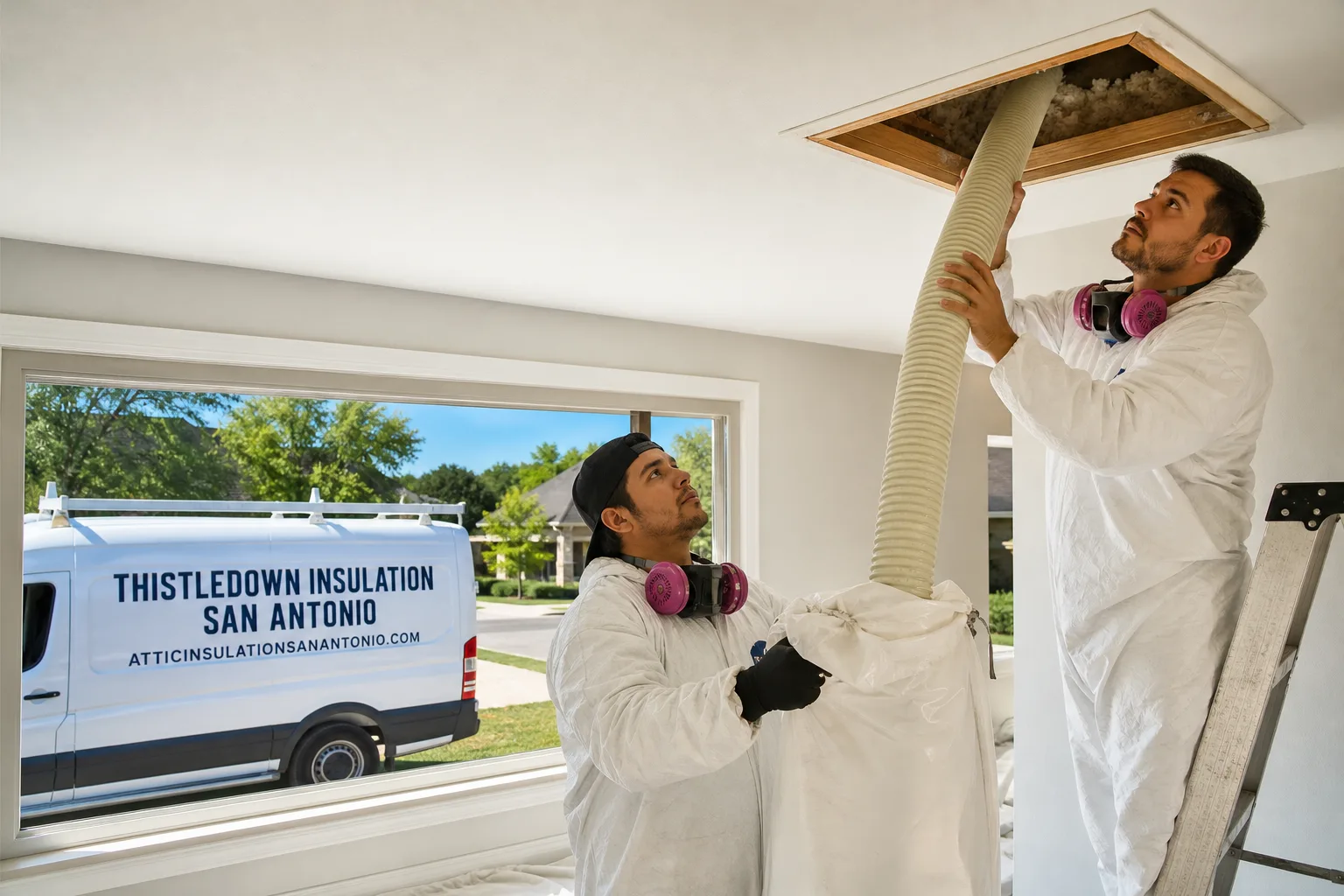
Our crews are background-checked and uniformed. We lay drop cloths across your hallway and wear shoe covers from the front door to the attic hatch. Every job carries the 365-Day Done Right Promise. If it’s not done right, we make it right. No debate, no fine print.
Thistledown is the soft fluff of the thistle, one of nature’s lightest insulators. The name is a promise about how carefully we work in your home. Quiet tools when children are sleeping. Ask before we move or touch anything. Respect the family’s time and quiet hours. Explain the price before the work. And clean up like it’s our own home, with a photo of the finished space before the van pulls away.
Your home is where your kids sleep and your dog naps through the afternoon. Your attic is the buffer between that home and a San Antonio summer. We take both seriously. If you’re ready to get a real number for your Attic Insulation in San Antonio project, call (903) 437-9164. A live person answers, day or night, and the estimate is free.
Pricing reflects the San Antonio market as of 2026. Thistledown Insulation San Antonio offers free estimates. Call (903) 437-9164. Written by Neil Barron, Owner at Thistledown Insulation San Antonio, serving San Antonio since 2003.
What Our Customers Say
"Attic insulation with a newborn in the house. The crew was quiet, laid protection on every floor they crossed, and hauled off all the old material. Left it spotless and the house is cozier already."
- Corinne Dyer"Removed the old flattened insulation and blew in new. They were so careful not to track anything through the house, booties on, drop cloths down. Cleaned up spotless after."
- Kelvin Osei"Careful and clean from start to finish. They covered the hallway, wore booties, and hauled off all the old material without leaving a speck. Respectful of the home the whole time."
- Brett Yamamoto