
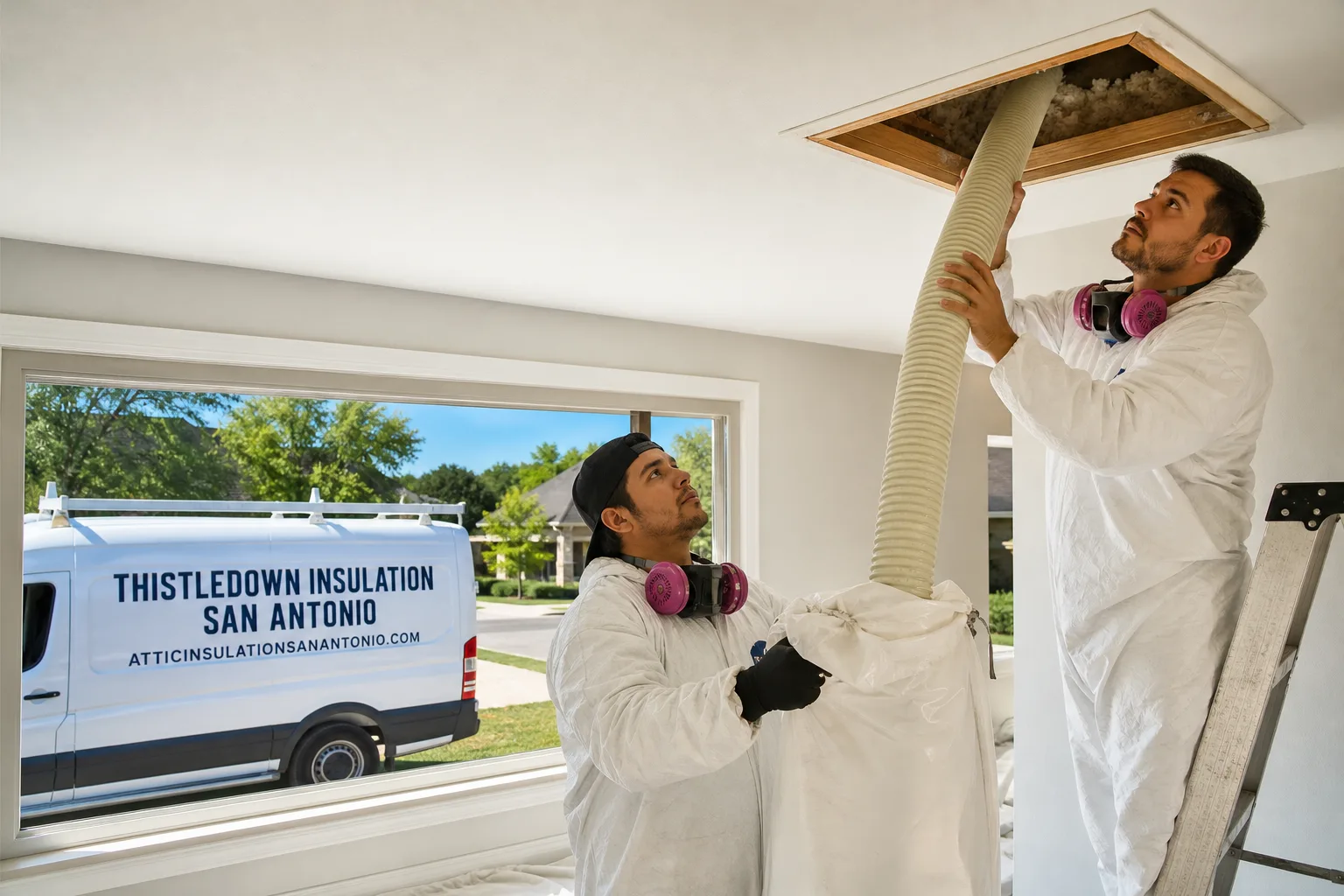
How Much Does Attic Cleaning & Rodent Proofing Cost in San Antonio?
Attic cleaning and rodent proofing in San Antonio typically runs between $1,200 and $3,800 for a full job, with most homes landing around $1,800 to $2,600. The work includes removing contaminated insulation, vacuuming droppings, sanitizing the attic deck, sealing entry points, and installing fresh insulation where the old material was pulled out. You’ll get an exact written price before any work begins, so the number you’re quoted is the number you pay.
Rodent activity in San Antonio attics is a year-round problem, but it spikes hard in late fall and early winter when roof rats and house mice look for warmer nesting spots. The good news: a proper cleaning and exclusion job fixes the problem at the source rather than just masking it. The bad news: if you skip the sealing step, you’ll be paying for another cleanup within a year. We see it all the time in neighborhoods like Alamo Heights, Stone Oak, and Helotes, where mature trees and older rooflines give rodents easy highway access to attic spaces.
At Thistledown Insulation San Antonio, every attic cleaning and rodent proofing job starts the same way: a technician walks the home with you, inspects the attic, identifies entry points, and then hands you a written price. No ranges, no “we’ll see when we get up there.” The number is fixed before we touch a rafter.
Attic Cleaning & Rodent Proofing Cost Breakdown (2026)
Here’s what San Antonio homeowners can expect to pay for each piece of the work, based on current market rates and typical attic sizes in the area (most San Antonio homes run 1,200 to 2,200 square feet of attic floor space).
| Service Component | Typical Cost Range | What It Includes |
|---|---|---|
| Full attic inspection | $0 – $150 | Entry point mapping, damage assessment, moisture check. Often free with a quote. |
| Contaminated insulation removal | $600 – $1,500 | Bagging and disposal of old insulation with droppings, urine-soaked material, and nesting debris. |
| HEPA vacuuming of attic deck | $300 – $800 | Removal of droppings, nesting material, and debris from the entire attic floor. |
| Attic sanitization and deodorizing | $250 – $500 | Application of enzyme-based cleaner that breaks down urine residue and bacteria. |
| Rodent proofing / entry point sealing | $400 – $1,200 | Sealing roof gaps, gable vents, soffit openings, and plumbing penetrations with steel mesh and sealant. |
| New insulation installation | $800 – $2,400 | Blown-in fiberglass or cellulose to replace what was removed; R-value matched to San Antonio’s climate zone. |
| Whole-job bundle (common) | $1,200 – $3,800 | Cleaning, sanitizing, sealing, and re-insulating in one visit, often with a bundled rate. |
Most San Antonio homes need the full bundle rather than a single component. Once insulation is contaminated, leaving it in place means living with the ammonia smell and the health risks that come with rodent waste. A partial job saves money short-term and costs more within 18 months when the next family of roof rats moves in through an unsealed gap.
What moves the price up or down? Attic size is the biggest lever. A 900-square-foot attic in a Jefferson-area bungalow costs less to clean and re-insulate than a 2,400-square-foot attic in a Dominion estate home. The age of the home matters too. Older San Antonio houses, especially those built before 1980, often have more entry points and more unusual framing that takes longer to seal properly. Accessibility counts as well: steep roof pitches in the Hill Country parts of the metro area, or attics with low clearance, add labor time.
What Affects Attic Cleaning & Rodent Proofing Pricing in San Antonio
Here are the factors that shape your final price, specific to how homes are built and how rodents behave in this part of Texas.
- Attic square footage. Bigger attics mean more insulation to remove, more surface area to sanitize, and more linear feet of roofline to inspect for gaps. A 1,500-square-foot attic in a Castle Hills ranch costs noticeably less than a 3,000-square-foot attic in a Shavano Park two-story.
- Severity of rodent activity. A few droppings near the hatch is a different job than a decade of accumulated waste, chewed wiring, and tunneled insulation. Heavier contamination requires more labor hours, more disposal bags, and more enzyme cleaner.
- Number of entry points. Some San Antonio attics have one obvious gap at a gable vent. Others have a dozen openings: soffit intersections, roof-to-wall junctions, plumbing stacks, and old chimney chases. Each sealed point adds material and time.
- Type and condition of existing insulation. Blown-in fiberglass from the 1990s vacuums out fast. Dense-packed cellulose from a retrofit job takes longer. If the old insulation is wet from roof leaks, that adds disposal weight and can mean additional repairs before new insulation goes in.
- Roof and attic access difficulty. Attics in San Antonio’s older neighborhoods, like Government Hill or Tobin Hill, often have sharply pitched roofs and tight access hatches. Technicians work slower in those conditions, which shows up in the labor line item.
- Time of year. Rodent calls spike in October through February across Bexar County as roof rats push indoors. Winter demand can mean slightly higher scheduling pressure, though cleaning rates themselves stay consistent. Booking in spring or summer often means faster scheduling.
How to Save on Attic Cleaning & Rodent Proofing
This is not a job where you want to shop for the rock-bottom bid. The cheapest quote usually skips the sealing step or leaves contaminated insulation in place, and you’ll pay for a second cleanup inside two years. That said, there are a few legitimate ways to keep the total reasonable without cutting corners.
First, bundle the work. Cleaning, sanitizing, sealing, and re-insulating in one visit is cheaper than four separate trips, and it means one clean-up, one crew, one warranty. Second, address the problem the week you notice it. A few droppings by the hatch is a smaller, cheaper fix than a full infestation that has been running for six months. Third, trim tree branches that overhang your roof. Roof rats in San Antonio use oak and pecan limbs as a bridge from tree to attic. Removing that access costs you a tree service visit, not an insulation company visit, and it genuinely reduces repeat infestations.
Fourth, get a written quote before you commit. Every Thistledown job includes a written price before any work begins, so you can line up the numbers side by side and see exactly what each company is actually doing for the money. If a quote does not include entry point sealing, it is not a real rodent proofing quote. Call (903) 437-9164 and we’ll walk your attic with you, show you what we found, and put the number in writing. Estimates are free.
One more thing worth mentioning: our home service area covers the full San Antonio metro, and our crews work in neighborhoods from Leon Valley to Universal City. If you’re in the city limits or just outside, we can usually schedule an inspection within a few days of your call.
Why San Antonio Attics Have More Rodent Problems Than You’d Expect
San Antonio’s climate creates ideal conditions for attic rodents in ways that colder cities do not deal with. Roof rats are the primary culprit here, and they thrive in the live oak canopies that dominate neighborhoods from Terrell Hills to Olmos Park. Those branches often touch or overhang rooflines, giving rats a protected route from tree to attic vent without ever touching the ground.
The second factor is construction style. Many San Antonio homes, especially those built during the 1960s through 1990s boom, used attic construction methods that leave small gaps at soffit intersections and eave corners. Those gaps are invisible from the ground and rarely sealed at the time of building. A roof rat needs an opening about the size of a quarter to squeeze through. Most San Antonio attics have several openings that size or larger.
Once inside, the damage compounds fast. Rats and mice nest in insulation, tunneling through the material and compressing it so it loses its R-value. They chew on wiring, which is a fire hazard no homeowner should ignore. Their urine and droppings contaminate the air that circulates through your home. And the ammonia smell from established nests drifts down into bedrooms and living spaces, especially in summer when attic heat intensifies the odor.
This is why we treat attic cleaning and rodent proofing as one combined job rather than two separate services. You can read more about our process on our Attic Cleaning & Rodent Proofing in San Antonio page, but the short version is: remove the contamination, seal the entries, restore the insulation. Miss any one of those three steps and you’ll be back where you started.
What Actually Happens During an Attic Cleaning & Rodent Proofing Job
Understanding the sequence helps you understand where the money goes. Here’s how a typical Thistledown job unfolds in a San Antonio home.
Step 1: The walkthrough and written quote
A technician meets you at the house, puts on shoe covers, and inspects the attic with a flashlight and camera. They map every entry point they can find, check the insulation for contamination, and look for moisture issues. Then they show you photos and hand you a written price. No pressure, no “sign today” games. You get the number and you decide.
Step 2: Insulation removal
We lay drop cloths from the front door to the attic hatch so the cleaning gear never touches your hallway carpet or wood floors. The contaminated insulation comes out in sealed bags, carried down the ladder and straight to the truck. This is the messiest part of the job and the part where bargain crews cut corners by leaving the worst sections in place. We do not leave contaminated material above your family’s bedrooms.
Step 3: HEPA vacuuming and sanitizing
The attic deck gets vacuumed with HEPA-filtered equipment that captures droppings, nesting debris, and dust rather than pushing it into your living space. Then an enzyme-based sanitizer goes down across the entire attic floor. The enzyme breaks down urine proteins and bacteria at the source, not just the surface smell. This matters in San Antonio’s heat, where residual urine odor in an attic becomes overwhelming by June.
Step 4: Entry point sealing
This is the rodent proofing part of the job, and it is the step that determines whether your problem stays solved. We seal gaps with steel mesh and professional-grade sealant, not spray foam alone. Spray foam by itself works temporarily, but rats chew through it. Steel mesh anchored with sealant is the standard that keeps them out permanently. We work through the entire roofline, the soffits, the gable vents, plumbing penetrations, and anywhere else a gap exists.
Step 5: Fresh insulation
Once the attic is clean and sealed, we blow in new insulation to the recommended R-value for San Antonio’s climate zone. Our crews install products from eight manufacturers: Owens Corning, Johns Manville, Knauf, Rockwool, CertainTeed, Icynene, Demilec, and GreenFiber. That range exists so we can match the right product to your attic and your family’s needs, including pet-safe options where a choice exists. If your dog is home during the job, we choose accordingly.
Step 6: The clean-up photo
Before we leave, we take a photo of the finished attic and the clean-up, and we show it to you. The floors at the bottom of the ladder get vacuumed if any debris fell. The drop cloths come up. You get to see the finished space before we pull out of the driveway.
San Antonio-Specific Rodent and Attic Facts That Affect Your Price
Every city has its own attic ecosystem, and San Antonio’s shapes pricing in ways that generic national cost guides miss. Here are the local facts that actually matter when you are budgeting.
Roof rats are the dominant species. In San Antonio, the attic invader is almost always the roof rat, not the Norway rat and not just mice. Roof rats are smaller and more agile than their ground-dwelling cousins, which means they exploit entry points that other rodents cannot reach. They also reproduce fast, with a single female producing up to 40 offspring per year. A “small problem” in October can be a major infestation by January.
Live oaks create attic highways. The live oak canopies in Alamo Heights, King William, and Monte Vista are beautiful, but they also give roof rats a protected route from the treetops to your roofline. If your home has branches touching or within three feet of the roof, you have a standing invitation. Tree trimming is not part of an attic cleaning quote, but it is the single most effective thing you can do after we seal the attic to prevent a future problem.
Summer heat accelerates insulation breakdown. San Antonio attic temperatures regularly exceed 140 degrees in July and August. That heat degrades fiberglass and cellulose insulation over time, reducing its R-value even without rodent activity. When rodents tunnel through the material and compress it, the efficiency loss compounds. Replacing contaminated insulation with fresh, properly installed material restores both the sanitation and the thermal performance of your attic.
Older homes have more entry points and more charm. San Antonio’s historic districts are full of beautiful homes built before modern sealing standards existed. Those homes also tend to have more gaps, more unusual rooflines, and more layered renovations that create hidden openings. A 1920s craftsmant in Monticello Park will typically need more entry point sealing than a 2010 build in Cibolo, and that shows up in the quote.
FAQs – Attic Cleaning & Rodent Proofing Cost
How much does attic cleaning and rodent proofing cost in San Antonio?
Most San Antonio homeowners pay between $1,200 and $3,800 for a complete attic cleaning and rodent proofing job, with the typical total landing around $1,800 to $2,600 for a 1,500 to 2,000 square foot attic. The price includes insulation removal, HEPA vacuuming, sanitizing, entry point sealing, and new insulation. Call (903) 437-9164 to schedule a free walkthrough and get your exact written quote.
Is it cheaper to clean the attic myself?
DIY attic cleaning typically costs $200 to $500 in rental equipment, protective gear, disposal bags, and sanitizing products, but it rarely includes proper entry point sealing, and it carries real health risks from airborne rodent waste. Without professional-grade HEPA equipment and enzyme sanitizers, you’re moving contaminated material around rather than removing it. Most homeowners find that a professional job at $1,800 to $2,600 is the better value, especially when the result is a guaranteed clean and sealed attic.
Can you clean and rodent proof my attic the same day?
Yes. Most attic cleaning and rodent proofing jobs in San Antonio are completed in a single day, typically 5 to 8 hours depending on attic size and contamination level. Larger homes over 3,000 square feet, or attics with especially heavy rodent activity, may require a second day. Call (903) 437-9164 during your inspection to confirm timing for your specific home.
How much does attic insulation replacement cost in San Antonio after rodent damage?
Replacing rodent-contaminated insulation in San Antonio costs between $800 and $2,400 for a typical attic, or roughly $0.80 to $1.50 per square foot for materials and installation. The final number depends on the insulation type, the R-value you choose, and the size of your attic. We install products from Owens Corning, Johns Manville, Knauf, Rockwool, CertainTeed, and GreenFiber, and we’ll help you choose the right option for your home and your budget.
How do I know if the rodents are actually gone after the cleaning?
A proper rodent proofing job seals every entry point with steel mesh and professional sealant, which means new rodents cannot get in once the cleaning is done. We document every sealed gap with photos during the job, and our 365-Day Done Right Promise means if rodents return through any area we sealed within a year, we make it right at no charge. If you hear attic noise within the first week after a Thistledown job, call us immediately; it is usually residual activity from a rodent that was already out feeding when we sealed the entries, and we’ll handle it.
Does the price of attic cleaning include disposal fees in San Antonio?
Yes. Our quotes include all labor, materials, disposal fees, and clean-up. There are no extra line-item surprises for hauling away contaminated insulation or for the debris that comes down the ladder. The written price you receive before work begins is the total price. San Antonio’s landfill fees for construction and insulation debris are included in every quote.
What Makes Thistledown Different on This Kind of Job
Attic cleaning and rodent proofing is invasive work. There is a crew in your attic, a hose running through your hallway, and dust that wants to find its way onto your floors. The difference between a good experience and a bad one usually comes down to how the crew treats the parts of the house that are not the attic.
We built our process around that reality. Shoe covers go on at the front door and stay on until the van. Drop cloths run from the entry to the attic hatch, so the vacuum hose and the bagged insulation never touch your floors. We clean up as we go, and we show you a photo of the finished attic and the clean-up before we leave. That is part of the Cedarwell Care Promise, and it is not optional.
Neil Barron, who leads Thistledown Insulation San Antonio, puts it simply: the name Thistledown comes from the soft fluff of the thistle, one of nature’s lightest insulators. The name is a promise about how carefully we work. A job like attic cleaning puts that promise to the test, because the work is inherently messy. The test is whether the homeowner sees any of that mess.
We answer the phone with a live person 24 hours a day, 7 days a week. If you hear rodent noise in your attic at 11:30 on a Sunday night, you can call and talk to a real human being who will tell you what to do and schedule an inspection. No voicemail tree, no “we’ll call you back during business hours.”
When to Call About Your San Antonio Attic
The right time to call is the first time you notice any of these signs: scratching sounds in the ceiling at night, droppings in the attic or around the exterior of the house, a stale ammonia smell in upstairs rooms, chewed or displaced insulation visible at the hatch, or unusual energy bills during summer months when your attic insulation should be doing its job.
Rodent problems do not self-resolve in San Antonio. The climate, the trees, and the housing stock all work in the rodents’ favor, and the problem compounds monthly. A raccoon-sized problem today becomes a full-blown attic contamination in one season. If you have any suspicion that something has been living in your attic, the most cost-effective move is to get it assessed now.
Call (903) 437-9164 to schedule a free attic inspection and walkthrough. You’ll get a written price before any work begins, and you’ll know exactly what you’re dealing with before you decide anything.
Pricing reflects the San Antonio market as of 2026. Thistledown Insulation San Antonio offers free estimates – call (903) 437-9164.
Written by Neil Barron, Owner at Thistledown Insulation San Antonio, serving San Antonio since 2003.
What Our Customers Say
"Attic insulation with a baby in the house. The crew was quiet, clean, and protected every floor they crossed. Took away all the debris and left it tidy. Already feeling the difference in comfort."
- Omar Leon"Attic insulation with a newborn in the house. The crew was quiet, laid protection on every floor they crossed, and hauled off all the old material. Left it spotless and the house is cozier already."
- Corinne Dyer"Removed the old flattened insulation and blew in new. They were so careful not to track anything through the house, booties on, drop cloths down. Cleaned up spotless after."
- Kelvin Osei