
How Much Does Insulation Cost in San Antonio?
Attic insulation in San Antonio typically costs $1.75 to $4.50 per square foot installed, depending on material and depth. For a standard 1,500-square-foot attic, most homeowners pay between $2,600 and $6,800 total for a complete job. Spray foam runs higher, usually $4 to $7 per board foot, which puts a sealed attic spray foam project between $6,000 and $14,000.
These numbers reflect what our crews actually see across Alamo Heights, Stone Oak, Helotes, and the older neighborhoods inside Loop 410. You should not have to guess, and with Thistledown you do not: every job gets a written price before anyone climbs the ladder. Call (903) 437-9164 and a live person will answer, day or night, and schedule a free attic assessment.
Insulation Cost Breakdown (2026)
Here is what San Antonio homeowners are paying in 2026 for the most common insulation projects. These ranges come from our own estimates and the jobs we have completed in neighborhoods from Alamo Ranch to Terrell Hills.
| Insulation Type | Cost Per Square Foot (Installed) | Typical 1,500 sq ft Attic Total | Best For |
|---|---|---|---|
| Fiberglass batt (R-30 to R-38) | $1.75 – $2.75 | $2,600 – $4,100 | Open attics with standard joist spacing |
| Blown-in fiberglass (R-38) | $1.50 – $2.50 | $2,250 – $3,750 | Attics with irregular framing, older homes |
| Blown-in cellulose (R-38) | $1.60 – $2.60 | $2,400 – $3,900 | Heat resistance, sound dampening, pet-safe options |
| Rockwool batt (R-30) | $3.00 – $4.50 | $4,500 – $6,800 | Fire resistance, soundproofing, allergy concerns |
| Open-cell spray foam (R-21, 5.5″) | $4.00 – $5.50 per board foot | $6,000 – $8,250 | Air sealing plus insulation in one step |
| Closed-cell spray foam (R-38, 5.5″) | $5.50 – $7.00 per board foot | $8,250 – $10,500 | Maximum R-value per inch, moisture barrier |
The total you pay comes down to four things: the square footage of your attic floor or roofline, the R-value you want to reach, the product our estimator recommends for your specific attic, and whether any old insulation needs to come out first. San Antonio homes built before 1980 often have thin, settled insulation that must be removed before new material goes in, which adds $1 to $2 per square foot.
Here is the part most companies will not tell you until the invoice arrives: a quote with a big range is not a quote. That is a guess. Thistledown puts a single number in writing before any work starts. If the job runs long due to tight attic access or unexpected joist repairs, that cost is covered by the 365-Day Done Right Promise, and we figure it out without touching your budget. Neil Barron and the crew believe a handshake means less than a written price, which is why you will have both.
What Affects Insulation Pricing in San Antonio
San Antonio has its own pricing dynamics that differ from Dallas or Houston. Here is what moves the number.
- Attic access and ceiling height. Older homes in Monte Vista and King William often have small scuttle holes and steep, low-pitched rooflines. Tight access means crews work in shorter shifts and move material by hand, which adds labor hours to blown-in jobs.
- Existing insulation condition. Homes built before 1985 in Leon Valley and Castle Hills frequently have original fiberglass batts that have compressed to a fraction of their rated R-value. Removing and bagging that material costs $1 to $2 per square foot before new insulation goes down.
- Radiant barrier demand. Many San Antonio homeowners add a radiant barrier to the attic underside for $0.75 to $1.50 per square foot. It is a heat-specific upgrade that makes sense in our climate, where attic temperatures hit 140°F in August.
- Product choice and brand. We install eight product lines: Owens Corning, Johns Manville, Knauf, Rockwool, CertainTeed, Icynene, Demilec, and GreenFiber. Each has different price points. Rockwool and closed-cell Icynene sit at the top of the range. GreenFiber cellulose offers a strong R-value per dollar and is the choice when homeowners want a recycled, pet-friendly material.
- Air sealing scope. In San Antonio, where summer humidity rides in through every bypass, our crews often find 30 to 50 linear feet of penetrations around can lights, plumbing stacks, and flue chases. Sealing them with foam and caulk runs $300 to $800 depending on how many gaps exist.
- Seasonal scheduling. Attic work in San Antonio slows down in July and August because attics get dangerously hot. If you schedule in spring or fall, crews work faster and cleaner, and prices hold steady. Summer emergency jobs may carry a slight premium for crew safety gear and hydration breaks.
None of these factors should be a surprise. Our estimator walks your attic with you on a video call or in person, points to what he sees, and explains what it means for the final number.
How Much Insulation Does a San Antonio Home Need?
The Department of Energy puts San Antonio in climate zone 2A, which means the recommended attic insulation level is R-38 to R-60. That is 12 to 16 inches of blown-in fiberglass or cellulose, or 10 to 14 inches of batt insulation depending on the product.
What our crews actually find in San Antonio homes: most attics built in the 1990s and 2000s have R-19 to R-30, which is roughly half of what the DOE recommends for our climate. A house in Stone Oak with R-19 in the attic is losing air-conditioned air from May through September, and the AC unit in the garage is working against the ceiling every afternoon.
Here is the math we walk through with every homeowner. Upgrading from R-19 to R-38 in a 1,500-square-foot attic in San Antonio typically costs $2,400 to $3,900 in blown-in fiberglass. Upgrading to R-49 runs $3,200 to $5,100. The difference in material cost between R-38 and R-49 is often under $600, and the extra depth pays back within three to five years in our climate. Many homeowners choose R-49 for exactly that reason.
Spray foam changes the calculation. Closed-cell foam at 5.5 inches gives you about R-38, but it also air-seals the roofline, which reduces the attic temperature itself. In San Antonio summers, a sealed foam attic can run 20 to 30 degrees cooler than a vented attic, and that means the air handler in the attic is not fighting 140-degree heat. That comfort difference is real, and it is why many families in newer builds around Fair Oaks Ranch and Schertz choose foam despite the higher upfront cost.
Blown-In vs. Batt vs. Spray Foam: What San Antonio Homeowners Should Know
Each insulation type does something specific well. The right choice depends on your attic, your budget, and what your family needs.
Blown-in fiberglass or cellulose is the workhorse of San Antonio attics. It fills around odd joist spacing, covers existing batts, and installs fast. Cellulose from GreenFiber has the added benefit of being made from recycled paper treated with borate, which resists pests and fire. It also settles into every corner, which matters in older San Antonio homes where framing is anything but square.
Batt insulation costs more per square foot than blown-in but works well in open attics with standard framing. Owens Corning and Johns Manville both make batt products we install regularly. Batts are also easier to move if you plan to use your attic for storage or need to access wiring later.
Spray foam is the premium option. Icynene and Demilec are the two foam brands we install. Open-cell foam expands to fill cavities and air-seals while it insulates. Closed-cell foam adds a moisture barrier, which helps in San Antonio’s humid months when condensation can form on ductwork in vented attics. Foam costs two to three times more than fiberglass, but it is the only option that turns the attic into a conditioned space.
We do not push foam on every homeowner. For most San Antonio homes, a deep layer of blown-in cellulose or fiberglass at R-49 is the right balance of cost and performance. When a homeowner asks about foam, we walk through the full cost picture so they can decide with clear numbers, not a sales pitch.
How to Save on Insulation in San Antonio
Insulation is one of the few home improvements that pays for itself, but that does not mean you should overpay. Here is how San Antonio homeowners keep insulation costs in check.
- Combine air sealing with insulation. The most expensive mistake is insulating a leaky attic. If your attic has unsealed can lights, plumbing chases, or a flue gap, you will pay to cool air that leaks straight through the new insulation. Sealing those gaps first costs a few hundred dollars and makes every inch of insulation work harder.
- Check CPS Energy rebates. CPS Energy has offered insulation rebates in the past through its home efficiency programs. The amounts change year to year, so ask our estimator what is current or call CPS directly. We have helped homeowners in Alamo Heights and beyond apply for these, and the paperwork is not painful.
- Do not wait until August. Attic work in San Antonio’s summer heat is slower and harder on the crew. Spring and fall scheduling keeps labor costs predictable and means the crew can move efficiently without heat breaks every thirty minutes.
- Get a written price, not a range. A company that quotes $2,000 to $7,000 is asking you to bear the risk of the final number. Thistledown gives every homeowner a single written price before work starts. That alone can save you thousands compared to a competitor who starts at the low end and invoices at the high end.
- Ask what you are actually getting. R-30 and R-49 look similar in a quote but perform very differently in July. Ask for the R-value in writing. We put it on every estimate.
The easiest way to get an honest number: call (903) 437-9164 and book a free estimate. A live person answers, and the estimate is free whether or not you hire us.
Why San Antonio Homeowners Choose Thistledown
Thistledown is part of the Cedarwell family of independently owned insulation companies, and the name tells you how we work. Thistledown is the soft fluff of the thistle, one of nature’s lightest insulators. It is also a promise about how carefully we handle your home.
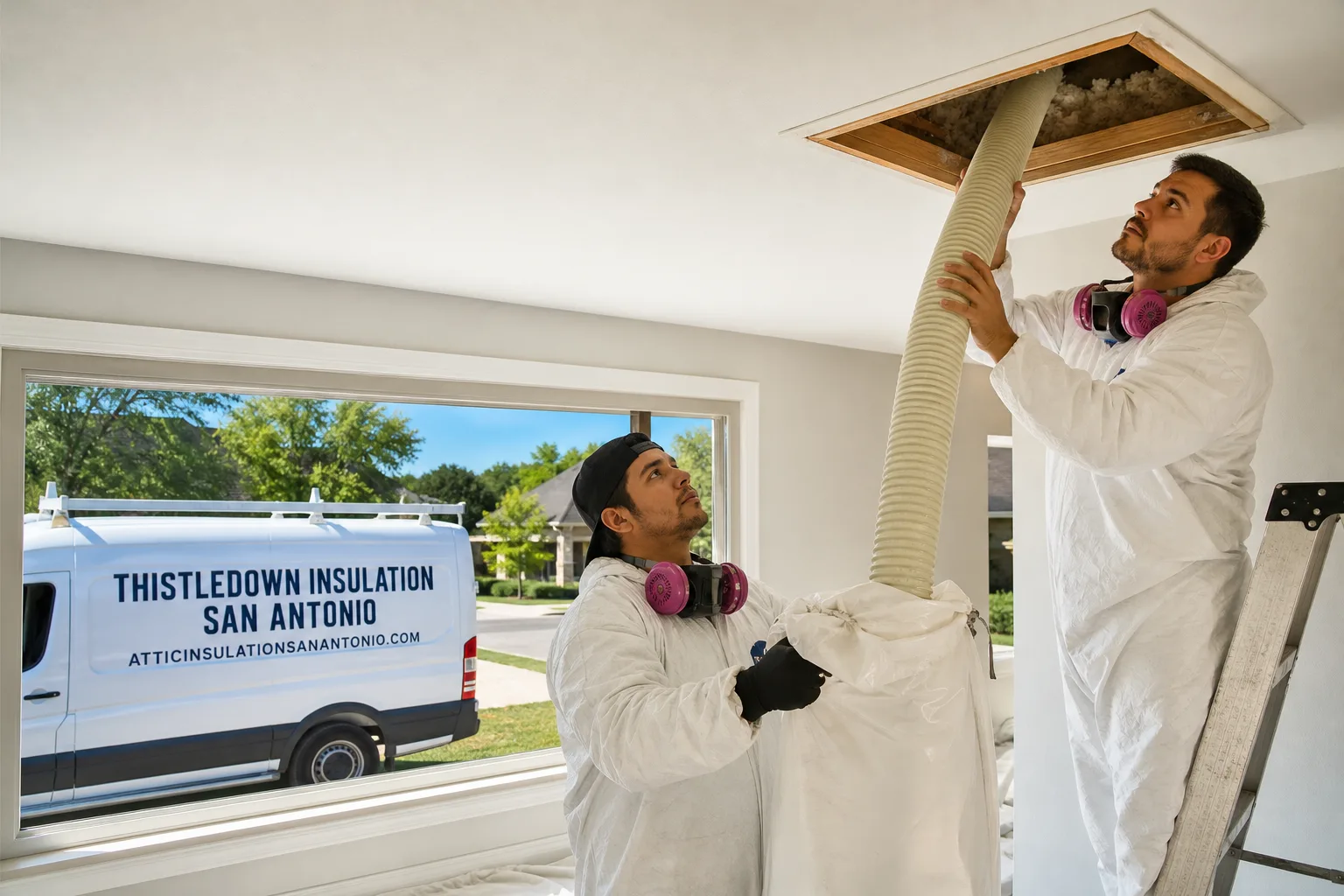
Every job, from a small patch in a Leon Valley ranch house to a full spray foam conversion in a Dominion estate, follows the same Cedarwell Care Promise. We lay drop cloths across your hallway and wear shoe covers from the front door to the attic hatch. We ask before we move or touch anything in your home. We respect quiet hours if a baby is napping or a night-shift parent is sleeping. And we photograph the clean-up before the van pulls away, so you can see the floor looks the way it did when we arrived.
We have been doing this since 2003, and we answer our own phones. Call at 2 a.m. and a live person picks up. That matters when you find a raccoon in the attic or a water stain spreading across the nursery ceiling and you need to know what happens next. We are not a call center. The person who answers knows insulation and knows San Antonio.
Our technicians are background-checked and uniformed, which means you know exactly who is walking through your front door. If you have a dog, we will ask where he likes to nap so we can plan around him. When a pet-safe product option exists for your job, we choose it and tell you why.
We install eight product lines: Owens Corning, Johns Manville, Knauf, Rockwool, CertainTeed, Icynene, Demilec, and GreenFiber. That matters because no single product is right for every attic. Our estimator will recommend a specific product for your attic and your goals, and explain the reasoning in plain English.
And the 365-Day Done Right Promise sits behind it all. If something is not done right, we make it right. No debate, no fine print, no chasing anyone down. Neil Barron and the team stand behind every attic we touch.
FAQs – Insulation Cost in San Antonio
How much does it cost to insulate a 1,500 sq ft attic in San Antonio?
Most 1,500-square-foot attics in San Antonio cost $2,600 to $6,800 to insulate in 2026, depending on the material and R-value. Blown-in fiberglass at R-38 runs $2,250 to $3,750, while Rockwool batts or spray foam push the total higher. The written price you receive from Thistledown is the price you pay. Call (903) 437-9164 for an exact quote, free of charge.
Is it cheaper to do blown-in insulation or batts in San Antonio?
Blown-in insulation is cheaper in San Antonio, typically $1.50 to $2.60 per square foot versus $1.75 to $4.50 for batts. Blown-in also fills irregular joist spaces better in older San Antonio homes. Batts make more sense if you plan to use the attic for storage or need to move sections for future electrical work. We will show you both options with real numbers before you commit.
How much does spray foam insulation cost in San Antonio?
Spray foam insulation in San Antonio costs $4 to $7 per board foot installed, which puts a typical attic roof deck project between $6,000 and $14,000. Open-cell foam runs lower, closed-cell higher. The air-sealing benefit and cooler attic temperatures justify the premium for many homeowners, but we will always show you the fiberglass alternative so you can compare honestly.
Does CPS Energy offer rebates for insulation in San Antonio?
CPS Energy has offered insulation rebates through its home efficiency programs, though the amounts and eligibility change seasonally. Some San Antonio homeowners have received $300 to $600 toward attic insulation upgrades in recent years. Ask our estimator for current CPS Energy program details when you call for a free estimate.
How long does attic insulation take to install in San Antonio?
Most attic insulation jobs in San Antonio take four to eight hours, including set-up, installation, and full clean-up. Spray foam takes longer, typically one full day for an average attic. We schedule around your family’s needs, including quiet hours for a napping baby or a night-shift worker.
Should I remove old insulation before adding new insulation in San Antonio?
If your existing insulation is wet, moldy, pest-damaged, or compressed below half its original depth, removal is the right call. Removal adds $1 to $2 per square foot in most San Antonio homes. If the old material is dry and intact, we can often blow new insulation directly over it, which saves money without sacrificing performance. Our estimator will check with a moisture meter and show you photos before recommending a path.
Get Your Written Insulation Price in San Antonio
You should not have to wonder what your attic insulation will cost. Call (903) 437-9164 today and a live person will answer, ask a few questions about your home, and schedule a free attic assessment at a time that works for your family. You will get a specific product recommendation, an honest R-value recommendation for San Antonio’s climate, and a single written price before any work begins. That is how Thistledown has done it since 2003, and that is how we will do it for your home.
Written by Neil Barron, Owner at Thistledown Insulation San Antonio, serving San Antonio since 2003.
Pricing reflects the San Antonio market as of 2026. Thistledown Insulation San Antonio offers free estimates – call (903) 437-9164.
What Our Customers Say
"Removed the old flattened insulation and blew in new. They were so careful not to track anything through the house, booties on, drop cloths down. Cleaned up spotless after."
- Kelvin Osei"Careful and clean from start to finish. They covered the hallway, wore booties, and hauled off all the old material without leaving a speck. Respectful of the home the whole time."
- Brett Yamamoto"Attic insulation with a baby in the house. The crew was quiet, clean, and protected every floor they crossed. Took away all the debris and left it tidy. Already feeling the difference in comfort."
- Omar Leon