
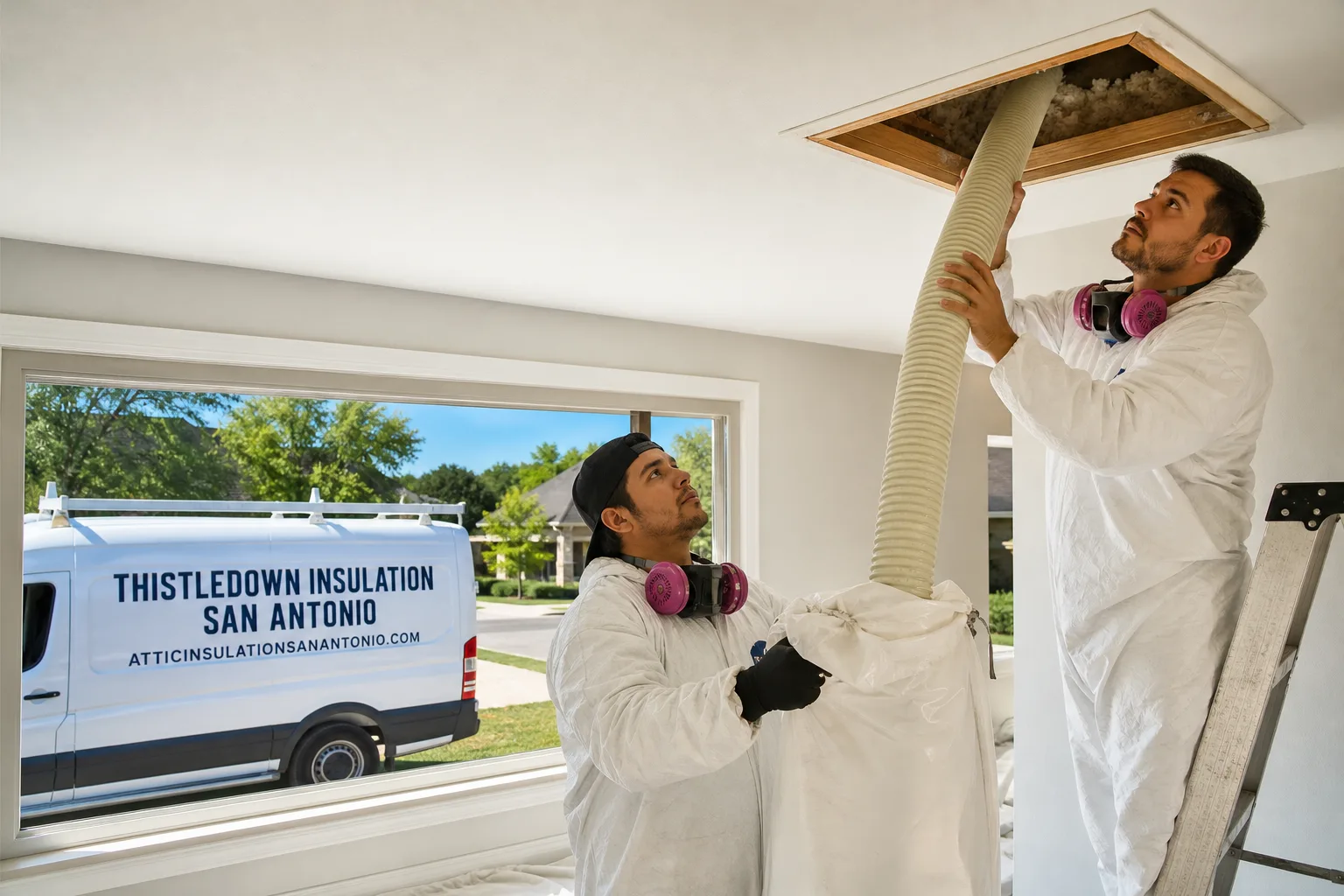
How Much Does Spray Foam Insulation Cost in San Antonio?
Spray foam insulation in San Antonio typically costs between $1.50 and $4.50 per board foot installed, with most whole-attic retrofits landing between $3,800 and $9,600 before any rebates. A 1,500-square-foot attic with 2×6 rafter bays usually runs $4,200 to $7,200 for closed-cell foam, which is the most common choice in our climate. Your exact written number depends on square footage, foam type, and how much prep the attic needs, but you should have that figure in hand before anyone picks up a tool.
We install our Spray Foam Insulation services across San Antonio every week, and we put the price in writing before work starts. That’s not a courtesy we offer on request. It’s the standard. No ranges that balloon after the crew arrives, no surprise line items for the attic hatch or the knee wall. Just a number on paper, followed by a clean job and a photo of the cleanup before we leave.
If you want a fast, accurate quote for your house, call (903) 437-9164. A live person answers, 24/7.
Key Takeaways
- Typical whole-attic spray foam job in San Antonio: $3,800 to $9,600, with most homes falling between $4,200 and $7,200.
- Per board foot pricing: $1.50 to $4.50 installed, depending on open-cell vs closed-cell and rafter depth.
- Closed-cell foam is the right call for most San Antonio attics because it handles both heat and humidity in one pass.
- You should always get a written price first. Thistledown Insulation San Antonio provides one on every job, no exceptions.
- Call (903) 437-9164 for a free estimate. Someone picks up the phone around the clock.
Spray Foam Insulation Cost Breakdown (2026)
Here is what spray foam insulation actually costs in the San Antonio market this year, broken down by the way contractors quote it. These reflect current 2026 pricing for retrofit attics in Bexar County, not national averages that do not account for our heat and humidity.
San Antonio Spray Foam Cost by Project Type
| Project Type | Typical Cost Range (Installed) | Notes |
|---|---|---|
| Attic roof deck (closed-cell), 1,000 sq ft | $3,800 – $5,400 | Most common retrofit in San Antonio. Makes the attic a conditioned space. |
| Attic roof deck (open-cell), 1,000 sq ft | $2,400 – $3,600 | Lower cost, but needs a vapor strategy in humid months. |
| Whole-attic retrofit, 1,500 sq ft home | $4,200 – $7,200 | Closed-cell on the roofline, plus air sealing around penetrations. |
| Crawl space encapsulation, 200 linear ft perimeter | $2,800 – $4,500 | Closed-cell on rim joists and perimeter walls. |
| New construction, walls + attic, 2,000 sq ft home | $9,000 – $16,000 | Closed-cell walls plus open-cell attic is common for builders. |
| Small spot job (garage ceiling, knee wall, or rim joist) | $900 – $2,400 | Good for targeted air leaks and hot spots. |
Per Board Foot Pricing
- Open-cell spray foam: $1.50 to $2.50 per board foot installed.
- Closed-cell spray foam: $2.25 to $4.50 per board foot installed.
- Board foot math: one board foot covers 1 square foot at 1 inch thick. A 2×6 rafter bay filled with 5.5 inches of closed-cell is 5.5 board feet per square foot of surface.
What does that mean for your house? A 1,500-square-foot attic with standard rafter depth treated at 5.5 inches translates to roughly 8,250 board feet of foam if we spray the entire roof deck. At $2.75 per board foot, which is a fair mid-range for closed-cell in San Antonio, that is about $5,700 before factoring any prep, masking, or cleanup. Some homes come in lower because the rafter bays are shallower or the attic footprint is smaller. Others run higher because the roof has dormers, complex valleys, or a steep pitch that makes the spray work slower.
We quote spray foam in San Antonio as a flat, written number after we measure the attic. Not an estimate range that stretches during the job. Not a per-board-foot guess. You get the total on a line, with the square footage and the foam brand specified, before you authorize anything.
What Affects Spray Foam Insulation Pricing in San Antonio
Several things move the number up or down, and most of them are specific to the way homes are built here and the weather they face.
- Attic size and rafter depth. A 2,400-square-foot home in Stone Oak has a lot more roof deck than a 1,100-square-foot bungalow in Jefferson. Deeper rafters mean more board feet per square foot of surface, which increases material cost.
- Open-cell vs closed-cell. Closed-cell runs about 70% more per board foot than open-cell, but it does two jobs at once: insulates and acts as a vapor barrier. In San Antonio, where attic temperatures hit 140°F in August, closed-cell is usually worth it.
- Attic access and prep work. Some attics in Alamo Heights and Monte Vista have tight hatches, low slopes, or old knob-and-tube wiring that must be addressed before foam goes in. Prep adds labor hours and occasionally requires an electrician’s sign-off.
- Air sealing scope. Good spray foam jobs include sealing around can lights, plumbing vents, bath fans, and the attic hatch. More penetrations means more prep time, but skipping them defeats the purpose of foam.
- Removal of old insulation. If your attic has fiberglass batts or blown-in material on the attic floor and you are converting to a conditioned attic, that old material usually needs to come out or be left in place depending on the approach. Removal adds $1 to $2 per square foot in labor and disposal.
- Roof geometry. Hipped roofs, dormers, tray ceilings, and multiple valleys all slow down the spray crew. San Antonio’s older neighborhoods, particularly King William and Olmos Park, have roof lines that require slower, more careful foam application than a simple gable in far northwest Bexar County.
One thing that should not affect your price: whether the crew decides to show up on time and clean up after themselves. We set the price based on the attic, not on how we feel that morning. And every job includes shoe covers, drop cloths, and a photo of the clean-up before the van leaves.
Closed-Cell vs Open-Cell Foam: Cost and Climate Reality in San Antonio
San Antonio sits in a climate zone that punishes the wrong foam choice. We get 105°F summers, high humidity from the Gulf, and winter cold snaps that dip below freezing just often enough to burst a pipe in an unconditioned attic. Closed-cell spray foam handles all three. Open-cell handles one and a half.
Closed-cell foam (2.25 to $4.50 per board foot) has a higher R-value per inch, around R-6.5 to R-7, and it acts as a vapor barrier at about 1.5 inches thick. That second property matters a lot in San Antonio, where warm, moist air pushes against your roof deck from inside the house. Without a vapor barrier, that moisture condenses inside the roof assembly, and then you are looking at mold on the rafters and a roof deck that rots from underneath. Closed-cell also adds structural rigidity to the roof, which helps in the hail and wind events we get every spring.
Open-cell foam ($1.50 to $2.50 per board foot) has an R-value around R-3.5 to R-4 per inch and is vapor-permeable. It is cheaper and does a fine job of air sealing and sound dampening, but in our humid climate it requires careful detailing to avoid trapping moisture. Some builders use open-cell in San Antonio attics, but they pair it with a robust ventilation strategy and a vapor-retarding primer on the drywall below. It is not a bad product. It is just a product that needs more conditions to be right here.
For most San Antonio homeowners retrofitting an existing attic, we recommend closed-cell. It costs more per board foot, but it solves the heat and the humidity in one layer, and it does not require the roof to be re-vented afterward. That simplification often narrows the total price gap more than the per-board-foot comparison suggests.
We also install open-cell where it makes sense, and we will tell you honestly which one fits your roof, your budget, and your plans for the attic. That conversation is part of the written quote, not a separate upgrade pitch.
How We Price a Spray Foam Job at Thistledown Insulation San Antonio
Most insulation companies in San Antonio quote a range, and the final invoice lands somewhere inside it, usually toward the top. We do not work that way.
Here is what happens when you call us about Spray Foam Insulation in San Antonio:
- You call (903) 437-9164. A live person answers. Not a voicemail tree, not a call-back queue. At 2 a.m. or 2 p.m., same response.
- We schedule a visit. A background-checked, uniformed technician comes to your house with shoe covers and a tape measure.
- We measure the attic. Square footage, rafter depth, penetrations, access points, existing insulation condition, and roof geometry. All of it goes into the calculation.
- We write the price down. One number, on paper, with the foam brand specified. You get it before any work starts. Always.
- If you approve, we schedule the job. The crew arrives with drop cloths, quiet tools, and a plan to protect your floors, your kids, and your pets.
- When the job is done, we photograph the clean-up. You see the proof before we leave.
And every job is backed by the 365-Day Done Right Promise. If it is not done right, we make it right. No debate, no fine print, no phone tag. That promise comes from the Cedarwell Care Promise standards that every independently owned Cedarwell location follows. Thistledown Insulation San Antonio is part of that family, and has been since 2003.
The name Thistledown comes from the soft fluff of the thistle, one of nature’s lightest insulators. The name is a promise about how carefully we work. We carry eight insulation brands, Owens Corning, Johns Manville, Knauf, Rockwool, CertainTeed, Icynene, Demilec, and GreenFiber, so the product matches the attic and the family who lives under it.
Spray Foam vs Fiberglass vs Cellulose: Cost in San Antonio
We install all three insulation types, and spray foam is not always the right recommendation for every house. Here is how the numbers compare for a typical 1,500-square-foot San Antonio attic.
- Spray foam (closed-cell, roofline): $4,200 to $7,200. Creates a conditioned attic. Highest upfront cost, best air sealing, best humidity control.
- Blown-in fiberglass (attic floor): $1,800 to $3,200. Cheaper. Keeps the attic hot and requires ventilation. Common in homes with already-decent ductwork in the attic.
- Blown-in cellulose (attic floor): $2,000 to $3,600. Slightly higher R-value than fiberglass. Good air-sealing at the floor level when dense-packed. Still leaves the attic unconditioned.
- Batt fiberglass (attic floor or walls): $1,500 to $2,800. Lowest cost for retrofits, but hardest to install without gaps, and gaps kill performance in August.
Spray foam costs more because it does more. It air seals, it insulates, it manages moisture, and it moves the thermal boundary from your attic floor to your roof deck. That shift matters in San Antonio because our AC equipment and ductwork sit in the attic in most homes. When the attic is 140°F and the ducts leak even slightly, your AC works harder than it should. Foam changes the math for the whole system.
Is it worth the premium? For homes with the budget and the right roof geometry, usually yes. For a tight budget on an older home with a ventilated attic that is already performing acceptably, cellulose or fiberglass may be the better call. We will tell you what we would do in your house, and then we will write down the price for each option so you can decide with real numbers, not brochure talk.
San Antonio Spray Foam Rebates and Utility Incentives in 2026
CPS Energy offers residential energy efficiency rebates that can offset part of a spray foam insulation project. As of 2026, the rebate amounts typically run $0.50 to $1.00 per square foot for qualifying insulation upgrades, with a cap that varies by program cycle. The specific number changes year to year, so the best move is to call CPS Energy or check their current rebate schedule before you commit to a foam job.
Federal tax credits for insulation under the Energy Efficient Home Improvement Credit also apply in 2026. Homeowners can claim 30% of qualifying insulation material costs, up to a $1,200 annual cap, when the work meets the program’s specifications. Spray foam qualifies when it is installed in a primary residence and meets the required R-value thresholds. Your tax advisor can confirm your eligibility, but it is real money that many San Antonio homeowners leave on the table.
One thing to verify before you buy: make sure your contractor is willing to document the foam thickness, R-value, and square footage in writing. Rebate programs and tax credits both require paperwork, and some also require a post-installation verification. At Thistledown Insulation San Antonio, the written price we give you also becomes the written record you need for rebates. We specify the product, the square footage, and the installed depth on every quote.
How to Save on Spray Foam Insulation in San Antonio
Spray foam is the most expensive insulation per square foot, but there are ways to get the price down without cutting corners.
- Combine it with air sealing instead of buying more foam. A thorough air seal around penetrations costs less per square foot than additional foam thickness and often delivers bigger comfort gains. We always include this in the quote.
- Strip the attic yourself, if you are comfortable doing it. Removing old insulation and clearing the space saves $1 to $2 per square foot in labor. We will give you a clear checklist of what to remove and what to leave. Wear a mask and gloves if you do this.
- Do it in the shoulder season. Spring and fall are slower months for San Antonio insulation crews. You may get better scheduling flexibility, and occasionally better pricing, than during July or January peak demand.
- Check with CPS Energy before you sign. The rebate can take several hundred dollars off the total, but only if the project qualifies and you file the paperwork.
- Get the written number before you commit. This saves you more than any coupon. When the price is on paper, you can compare options honestly. Call (903) 437-9164 for a free, written estimate with no obligation.
- Do not over-thickness the roof deck. In San Antonio, closed-cell at 5.5 inches on a 2×6 rafter bay delivers about R-36 to R-38, which exceeds code and performs well. Going beyond that brings diminishing returns for the money.
Is Spray Foam Insulation Safe for My Family and Pets?
This is a fair question, and we get it from parents in every neighborhood from Terrell Hills to Helotes. The short answer: yes, when it is installed correctly with the right products and the right protocols.
Modern spray foam products, including the Icynene, Demilec, and Owens Corning lines we install, are formulated to cure quickly and off-gas minimally. The key is the installation window. During spraying and for a curing period afterward, typically 24 hours but sometimes up to 72 hours for thick applications, the home should be ventilated and people and pets should stay out of the sprayed area. After the foam cures, it is inert.
We take this seriously. Our technicians wear full protective gear during application. We ventilate the attic with fans and open airflow paths to help the foam cure properly. We tell you exactly when it is safe to be back in the house, and we write that re-entry time on the job sheet. If your dog or cat is home, we contain the work area and keep the rest of the house isolated from spray activity.
We choose pet-safe insulation products where a choice exists, and we will tell you which brand is going into your attic and why. That is part of the written quote: brand name, product line, and thickness. No mystery products, no “contractor’s choice” line items.
Spray foam installation involves chemicals that should only be handled by trained professionals with proper ventilation equipment. This is not a DIY project you learn from a video. The two-part spray systems generate heat and fumes during application, and improper mixing or ventilation can create real hazards. We recommend hiring a trained professional crew for any spray foam work. For more on how we approach this, read about our home insulation services and what we do on every visit.
How Long Does Spray Foam Insulation Last in San Antonio?
Closed-cell spray foam installed correctly in a San Antonio attic should last the life of the home. It does not sag, settle, or lose R-value the way fiberglass batts and blown-in cellulose do over time. Open-cell foam also performs well over decades, though it is slightly more susceptible to moisture issues if the roof leaks and water sits against the foam.
The more realistic failure points are environmental: a roof leak that soaks the foam, a rodent infestation that damages it, or an installation mistake that leaves gaps. Our 365-Day Done Right Promise covers installation quality, and we will come back and fix any issue within that year. Beyond that, spray foam from the major brands we install carries a manufacturer’s warranty that typically runs 20 years to the life of the building, depending on the product line.
For San Antonio homeowners, the bigger question is usually not lifespan but performance. Does the attic stay cooler in August? Do the upstairs bedrooms finally match the downstairs temperature? Does the AC run less? Those are the results you will notice in the first summer after installation, and they tend to get better as the full air sealing effect settles in.
FAQs – Spray Foam Insulation Cost in San Antonio
Is it cheaper to repair or replace spray foam insulation?
Repairing damaged spray foam typically costs $3 to $6 per square foot of affected area, while replacing a full roof deck application costs $4,200 to $7,200 for a 1,500-square-foot San Antonio home. Repair is almost always cheaper if the damage is localized to a roof leak area, a plumbing chase, or a pest entry point. Replacement makes sense when the existing foam is old, thin, or poorly installed across more than 30% of the surface. Call (903) 437-9164 and we will tell you which path fits your attic.
How much does it cost to spray foam a 1,500-square-foot attic in San Antonio?
A 1,500-square-foot attic with closed-cell foam on the roofline costs $4,200 to $7,200 installed in San Antonio as of 2026. Open-cell runs $2,600 to $4,100 for the same footprint. Your exact number depends on rafter depth, roof geometry, and prep work, and we put it in writing before any work starts. Free estimates: (903) 437-9164.
Can you install spray foam insulation same day in San Antonio?
Small spot applications like rim joists, a garage ceiling, or a single knee wall can often be done the same day or next day, with prices from $900 to $2,400. Whole-attic retrofits typically require one to two days of scheduling, since the foam needs cure time after installation. Call (903) 437-9164 to check current scheduling; a live person answers 24/7.
Does spray foam insulation cause roof rot in San Antonio’s humidity?
Spray foam does not cause roof rot when it is installed at the correct thickness with proper air sealing. Closed-cell foam acts as a vapor barrier and prevents the warm, moist indoor air from reaching the roof deck, which is the main source of condensation in a San Antonio attic. Problems occur when improperly installed open-cell foam or thin closed-cell applications allow moisture to drive through, or when a roof leak goes unaddressed. We specify the correct product and depth for your home in writing.
Is spray foam insulation worth the cost in Texas?
For most San Antonio homeowners, closed-cell spray foam pays back through lower summer cooling costs, better indoor comfort, and protection from attic heat and humidity. Attic temperatures in San Antonio regularly hit 140°F, and foam brings the thermal boundary to the roofline, which changes the entire temperature profile of the house. The upfront cost is higher than fiberglass or cellulose, but the performance difference in our climate is real. We can quote both approaches so you can compare. Call (903) 437-9164.
Get Your Written Spray Foam Price in San Antonio
You should not have to guess what spray foam insulation will cost in your home. We will not make you guess. Call (903) 437-9164 and a live person will answer, 24 hours a day, 7 days a week. We will schedule a visit, measure your attic, and hand you a written price before any work begins. That is how every job at Thistledown Insulation San Antonio works, and it has been that way since 2003.
Written by Neil Barron, Owner at Thistledown Insulation San Antonio, serving San Antonio since 2003.
What Our Customers Say
"Removed the old flattened insulation and blew in new. They were so careful not to track anything through the house, booties on, drop cloths down. Cleaned up spotless after."
- Kelvin Osei"Careful and clean from start to finish. They covered the hallway, wore booties, and hauled off all the old material without leaving a speck. Respectful of the home the whole time."
- Brett Yamamoto"Attic insulation with a baby in the house. The crew was quiet, clean, and protected every floor they crossed. Took away all the debris and left it tidy. Already feeling the difference in comfort."
- Omar Leon